
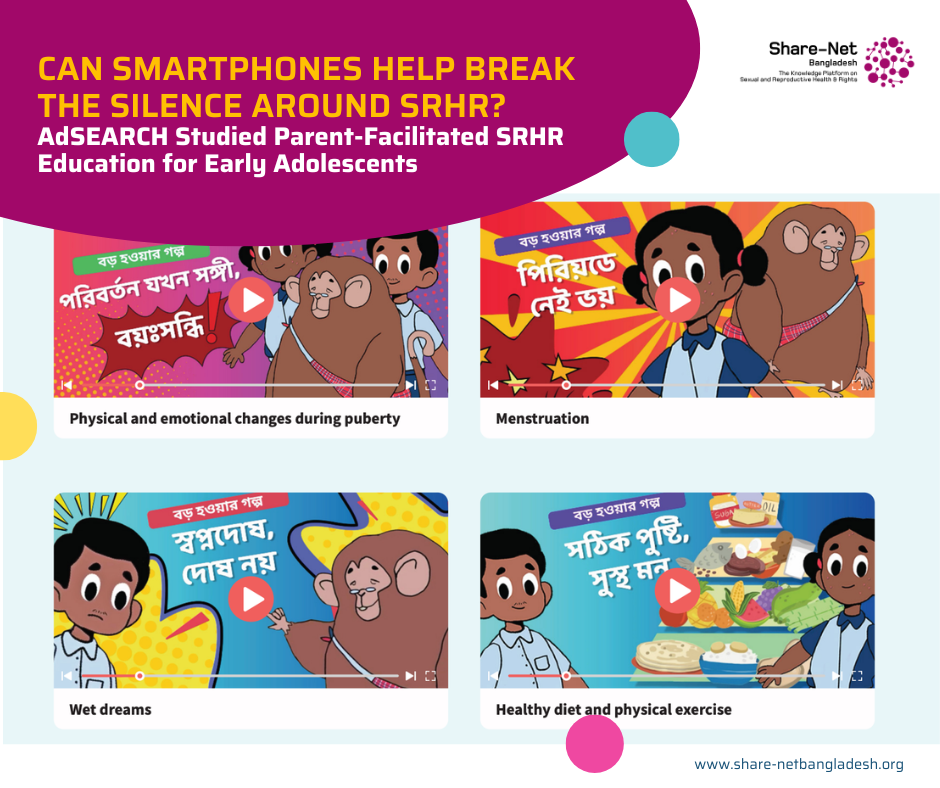
Can Smartphones Help Break the Silence Around SRHR? AdSEARCH Studied Parent-Facilitated SRHR Education for Early Adolescents
For many families in Bangladesh, conversations about puberty, menstruation, wet dreams, or sexual harassment still begin with silence. Parents often hesitate, schools struggle to provide comprehensive education, and adolescents turn to friends or social media for answers that are not always accurate. But what if the same smartphone often blamed for misinformation could become one of the country’s most effective tools for Sexual and Reproductive Health and Rights (SRHR) education?
A new study by icddr,b under the Advancing Sexual and Reproductive Health and Rights (AdSEARCH) project offers encouraging evidence that this is already possible.
Published in June 2026, the research evaluated a parent-facilitated smartphone-based SRHR education programme among 239 early adolescent and parent pairs in two rural villages of Matlab Upazila. Conducted between July and September 2025, the study explored whether culturally appropriate animated videos could improve adolescents’ knowledge of puberty, menstruation, wet dreams, healthy lifestyles, emotional wellbeing, sexual harassment, and cyberbullying.
The findings suggest they can.
Researchers found overwhelming acceptance of digital SRHR learning. Nearly 99 percent of both adolescents and parents said SRHR education is important. At the same time, the study exposed a significant communication gap. About 70 percent of adolescents reported never discussing SRHR with anyone, while 45 percent of parents admitted they had never initiated conversations on these topics.
Despite this hesitation, digital learning proved highly acceptable. Around 83 percent of adolescents preferred smartphone-based educational videos, while 95 percent of parents said they were willing to allow their children to access them.
The intervention demonstrated impressive reach and engagement. Nearly 70 percent of participants watched the videos, over 90 percent understood most of the content, and 97 percent said they would recommend the videos to friends.
Knowledge gains were substantial across nearly every topic. Awareness of puberty increased from 31 to 44 percent at baseline to 96 to 97 percent after the intervention. Understanding of wet dreams rose dramatically, with awareness increasing from 4 percent to 80 percent, while knowledge that wet dreams do not cause physical weakness reached 72 percent, correcting a long-standing myth.
Menstrual health knowledge also improved sharply. Awareness of menstruation increased from 45 percent to 95 percent, while correct understanding of how frequently menstrual products should be changed jumped from 8 percent to 74 percent. Misconceptions, including the belief that eating fish increases menstrual odor, also declined significantly.
Perhaps equally important were improvements in safety awareness. Knowledge of bullying increased from 17 percent to 95 percent, sexual harassment awareness rose from 8 percent to 95 percent, and cyberbullying awareness climbed from 12 percent to 91 percent.
Only a small proportion of participants faced technical barriers, with 6 percent lacking smartphones and 3 percent reporting internet connectivity problems. This suggests that smartphone-based SRHR education is increasingly feasible as Bangladesh continues to expand digital access. According to the latest Bangladesh Telecommunication Regulatory Commission (BTRC) statistics in 2026, the country now has well over 130 million mobile internet subscriptions, creating unprecedented opportunities for digital health education. At the same time, UNICEF and UNFPA continue to stress that adolescents need accurate, age-appropriate SRHR information to reduce early pregnancy, child marriage, gender-based violence, and misinformation.
The study’s strongest message may be its simplest. When parents become partners instead of barriers, and technology is guided by evidence rather than myths, young people are far better equipped to understand their changing bodies and protect their health.
In a country where conversations about puberty are still often whispered, this research shows that meaningful change may begin with something as familiar as a smartphone and something as powerful as a parent willing to start the conversation.